Christian Hanke – Looooongform | 5 perspectives on digital editorial
Attention to detail. Maximum respect for the customer. Narrative density. These are the key points on which Christian Hanke builds his work for numerous clients from start-ups to publishers and major clients such as Red Bull. Different levels of narrative in text, image, video and sound leave the reader intrigued. To quote from a reader's comment on Hanke's work: »The presentation of news will never be the same, ›Snowfall‹ has set new standards for passionate storytelling, whether in aesthetics or emotional density«.
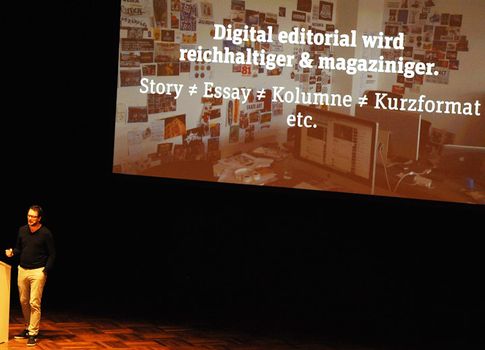
Five perspectives inform Hanke's role with regard to digital publishing: Atmospheric density is the most important. A story is not an essay, a column or short format text - to captivate and fascinate it needs its own language and grammar (see Horst Moser's lecture yesterday). In the richness of different forms of narrative style there is the potential to do this. There is no contradiction in focusing on key aspects. »Sometimes effects overwhelm the actual story,« says Christian Hanke. In approaching an actual topic, what actually works and what generates interest in the reader is, for Hanke, the special attraction of storytelling.
Among the interesting perspectives arising from responsive design: The path from the tablet to the browser and smartphone brings with it new possibilities, visual display capabilities that operate on different output devices without boundaries. The diverse publishing framework (which is no longer individually affordable considering the variety of different platforms and terminals) means that the designer of a story must consider clarity, suitability and proper implementation. Narrative focuses heavily on the user, not the designer and, in this context, digital publishing offers new methods of trial and error, responding rapidly to the audience's feedback. Christian Hanke states that »it's nice to listen first«, and makes the needs and experiences of users explicit.
Such flexibility within a fixed framework sets designers who are used to print new challenges in the form of hierarchies rather than positions, modules instead of pages. Components that were static in page layout are converted to freely combinable items in different grids. »It is important that we understand as designers that it is not about the items that we make but their functional interaction«. Not only at the formal level of the design but also in relation to the content, the focus on brand and key models (and, consequently, consistent positioning and attitude), are the building blocks of this interaction with reference to the respective product.
Christian Hanke/EdenSpiekermann online