Patrick Rössler - »There are even some nice pieces of work«
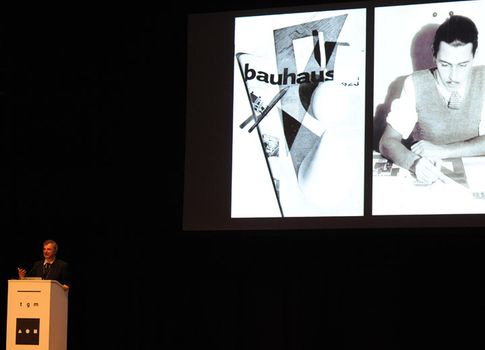
»There are even some nice pieces of work« suggests that Herbert Bayer’s works were anything but nice pieces of work. The former Bauhaus master, who had a difficult arrangement with the fascists until his final emigration in 1938, became famous for his designs, which were out of sync with the contemporary. Out of sync in that they were far ahead of their time. As evidence of this we might take some front pages of the Bauhaus magazine in 1928, later those of Harper’s Bazaar (1940, front page with serial portrait of a woman), the »Brücke« and the magazine »Schlesisches Heim«. Sans serif fonts, upper case letters, and the clear displacement of individual text blocks are elements of his future-pointing signature.
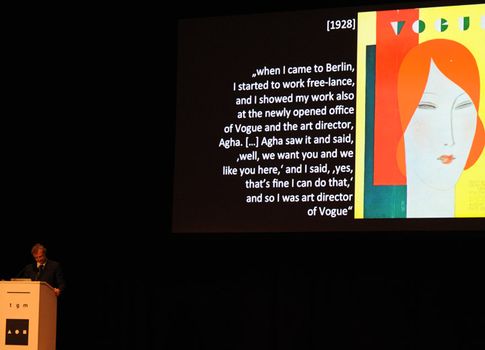
A portrait of Bayer from the year 1926 illustrates the artist’s attitude to work: the graphic designer as a manual worker and artist responsible for all production steps and designer of the product as a whole. An avant-garde approach that is reflected in this portrait – and one that catapulted Herbert Bayer rapidly to fame as art director of German Vogue – one of Germany’s most renowned magazines with a circulation of around 35,000 in the autumn of 1928. Asymmetric headlines, text columns and sans-serif fonts are characteristic of Bayer’s style and shaped the image of Vogue.
In the radicalness of his design, Herbert Bayer paved the way for future designers: free monochromatic spaces, use of small letters, the modernistic design elements of Bauhaus found their way towards everyday products via the magazine »die neue linie«. Even more interesting is Herbert Bayer’s vita during the Nazi era. What in some aspects, such as rationality and frugality, did not necessarily go against the ideology of the Nazis, was also initially less suspicious than art in its usefulness for the new rulers. As such, Bayer astoundingly had little problem until 1938 continuing to be design manager for »die neue linie«. Nevertheless, the designer decided in 1938 to emigrate, although his works doubtlessly served the purposes of political propaganda until 1936. His diaries and correspondence with his wife Irene show, says Patrick Rössler, how complicated the arrangement between Herbert Bayer and the fascists rulers was. Between private entanglements and professional successes, Rössler presents us with the picture of an enigmatic personality, and artist trapped between everyday life and vision.