Pekka Toivonen – What the FAT
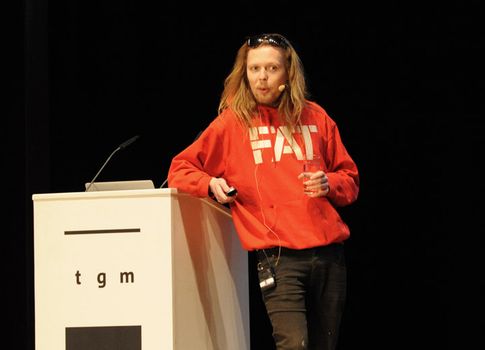
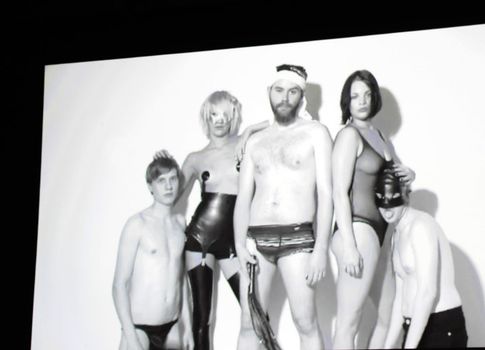
»Hello Munich!« roars Pekka Toivonen to his stunned audience. The crowd falls silent for a video that plays with conventions from the porn and sex industry. Between latex fetish, a quickie threesome, oversized plastic penises and cucumbers Toivonen creates an absurd world in which young people mimic an air of sexual disengagement. A sad world of clichés and porn gestures that forfeits any erotic charge and at the same time makes merciless fun of these conventions. This is art that you have to respond to. The audience was struck dumb for a moment.
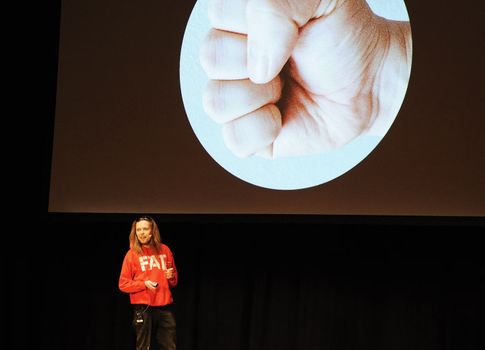
With a digitally overdriven soundtrack, a video documents, »the first, club-based record label in the world«, and its appropriation of the figure of the »Provo-Opa« from Norwegian myth. Even Toivonen finds it difficult to explain his unwieldy art. »If you like it, that's fine. If you don't like it, that's also fine« laughs the man in the red hoodie, along with his audience.
Behind the intimidating exterior there is a greater depth of concept than there appears at first glance: A mail Toivonen translated clarifies what the designer is talking about. Written in Norwegian, it does not literally address anyone in the audience but provides a beautiful, everyday example of his attitude to ideas and projects and the inherent expressivity of the work of art.
If an idea fails to convince at first sight, he laconically concludes, it is perhaps better to walk away and not even consider its implementation. The thrilling arc of Mike Meiré’s lecture yesterday incidentally postulated a similar notion, that the artist contributes both an idea and themselves. If the artist remains unconvinced, the experiment has failed - even before its implementation. So easy, so artless.
The deliberately imperfect staging of the video »FAT« is presented with a twinkle in the eye and yet invites the audience to more than laughter. The confusing chaos, in addition to strange stories about eccentric designers making an odd magazine, reveal a very different truth: that chaos itself involves the creation of a form of order which is generated by creativity. This insight is not new, but draws specifically from scientific research into chaos theory, which identifies (creative) chaos as order in its most complex form.
Pekka Toivonen online: www.wearekasino.com