Session I – Illustration and Introduction
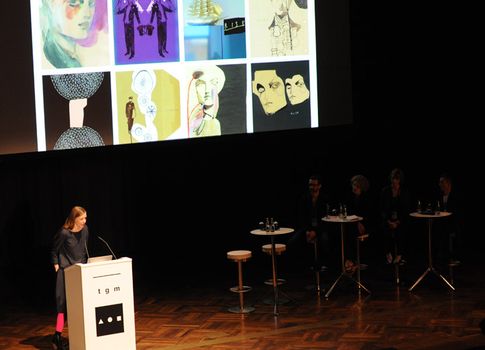
»A shoe box full of illustrators copied phone numbers,« is how Raban Ruddigkeit describes the beginnings of »freestyle«, a website that presents approximately 1,000 Illustrators - now sorted alphabetically, supplemented with stories and personal profiles which Ruddigkeit has here gathered into a selection of five:
»How can you make a pony on an assembly line?« asks Catherine Gschwendner in her presentation. She provides free projects in galleries and museums, drawing with pen and ink, working with unusual materials such as Perspex and needs otherwise only something »like the air to work with.« Small, educational stories of dwarves facing a giant miner, who remain lost for days. Whilst their exterior remains transparent, the characters created by Katharina Gschwendtner form narratives and statements which are characterised by their visual history, the traditions of woodcarving, narrative religious art, »Dances of Death« and fairy tales.
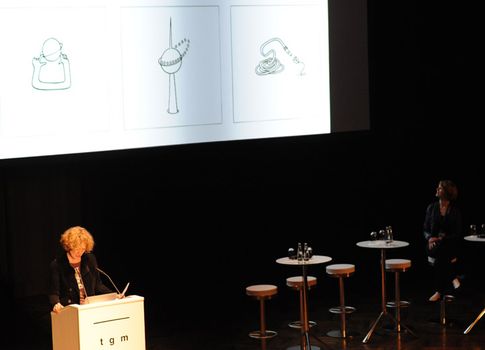
»With what you leave out of your drawings, you could fill entire exhibition halls,« said an employee of the Berlin Tagesspiegel of Martina Wember, when he wrote about one of her exhibitions. She dryly calls her work »minimally invasive« and whilst reduced to a few outlines her illustrations are recognisable and decipherable at first glance to the viewer. Their minimalist appearance offering visual breathing space in an image-saturated world.
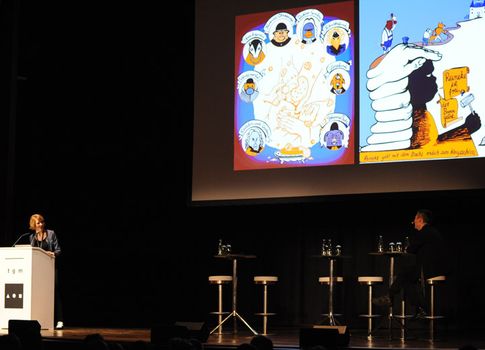
»As an Illustrator in a quiet closet one is actually very distant. We wanted someone directly on-site in Dakar making pictures,« says André Roesler of his stay in Africa. An exciting process of several days’ work in which the pure commercial artist was transformed as a draughtsman. Expressive works, including an installation made of found objects, found Roesler engaging with different levels and elements, drawing from his impressions of power, chaos, home building and social structure that emerged in his series, »Africa«.
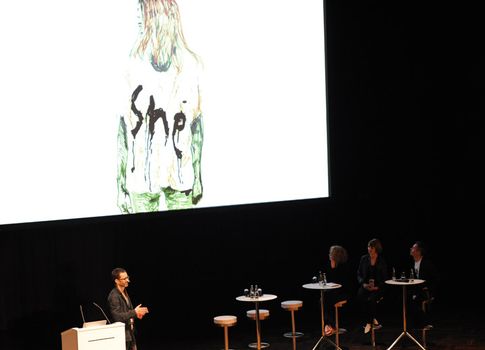
Daimler Benz, Stern, Süddeutsche Zeitung Magazine, Tiffany & Co. are just some of the numerous customers Tina Berning creates her imagery for as an illustrator. As a counterpoint to her commercial work, she created a blog called, »A Drawing a Day«: This unpaid work seeks conscious changes between the different spheres of the illustration world and acts as a generator and motor for creating and discovering the new in small details. Another important aspect of Tina Berning's work is portraiture. Whilst trying to depict each subject fairly and to show their essence, sometimes a charming quirk, such as a sixth finger on the hand of Pope Benedict XVI, appears.
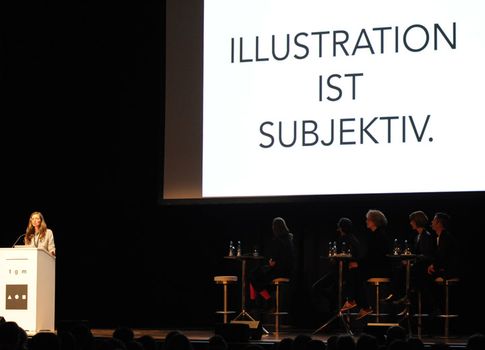
Illustration is in the main subjective, it polarizes. So says Gabriele Dünwald describing the fascination of the illustrations for Flair magazine and the development of its website which reflect both the craft as well as the optical concept of the magazine, the »High Air« in which it mainly deals with philosophy and ideas. It was obvious for Gabriele Dünnwald to implement these ideas with illustrations, a short synopsis serving as the basis for commissioned illustrators to develop a stand-alone idea. Maximum freedom - for a new kind of visual thinking.
The discussion offers bridges between different personalities, but teamwork and idea development, rather than quiet introspection behind closed doors, are the common basis of graphic design. Raban Ruddigkeit counters Tina Berning's idea that illustration is somehow deeper compared to photography and this content more valuable proposing that there is no competition, no weighting, instead illustration should be respected as an independent genre. Whilst the detailed descriptions of their everyday of work practices are self-conscious and partly tongue-in-cheek, time pressure makes for better jobs. Downtime for the Muse. The conscious renunciation of the magazine as a vehicle for idea generation. The question of trust, the bigger the client is, the more ideas it will be releasing at illustrators. Competition between digital and print? Probably not, rather, a clear differentiation. Time to stop and smell the roses, which is not contradict the speed, compression and opportunities presented by the digital world, but to complement them, as movement and sounds can - as with David Moretti's »Wired« - illustrations and the further enriching dimensions they add.
Illustration is not dead, long live illustration.
The participants of the round table on the we
Raban Ruddigkeit
Katharina Gschwendtner
Martina Wember
André Roesler
Tina Berning
Gabriele Dünwald