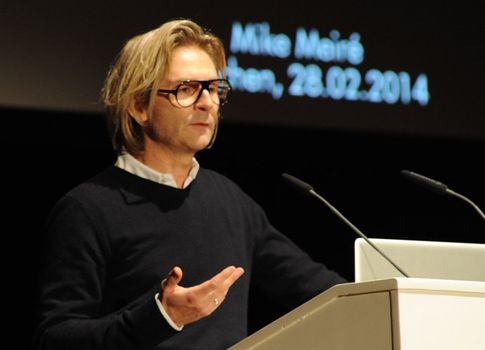
From wunderkind to grandmaster: Mike Meiré
»The really interesting approaches come if and when the individual is ready to accept his evolutionary plan.« Commenting on his initial thesis in the same breath, Mike Meiré dryly and concisely states: »I know that at first this sounds like shit...« The explanation is actually quite simple, as the values most important to the designer, once hyped as a child prodigy of design and today established in the international industry, are really rather old fashioned: Attitude. Subjectivity. Personality. »Things tend to polarise because they are so subjective. They have to. They may even have to hurt you.« What lies in the balance, is always the artist himself, according to Meiré. Beyond one's own comfort zone, where the inner demon has no more influence, creativity begins and culture is made.
Undue reverence in dealing with art is completely unrealistic for Mike Meiré. For him art is the basis and centre of life. Whether contractor or seller, in art we are both perpetrator and victim at the same time. Assuming this ambivalence is a given, for Meiré the economy of attention opens other nodes of thought, this occurs in unusual patterns of thinking, but also in unusual places.
Built in 1926, in Moscow, the industrial construction of the Bakhmetevsky Bus Garage provides both the title and nucleus of a new project. From a workshop for buses a workshop of ideas emerges, a magazine title is first constructed and the idea of its design evolves into visual representation, in illustrations and photography. The aesthetic codes of rhythm and construction in the design of Garage magazine echo the basic idea of the Russian entrepreneur and patron of the arts, Dasha Zhukova, who would like to merge fashion, art and literature in her project.
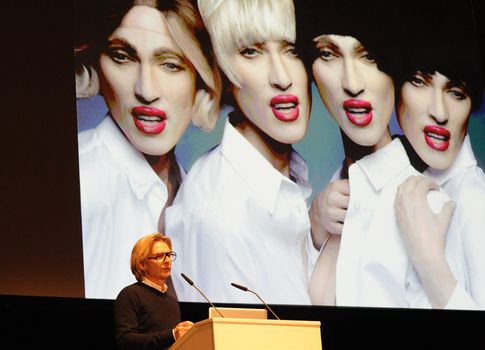
Another project was born out of collaboration with Zhukova, an exciting visual essay on the identity and personality, »Inked«, in which the works of famous artists were tattooed onto the skin of people cast specifically for the project. Freely adapted from the John Baldessari quote, »no more boring art«, one of the tattoos reads, »I will not wear any boring tattoos«. On people, art is literally under the skin. In the instance of a portrait of a bearded man, one of his shoulders sports a tribal design whilst on the other the smiling face of the artist Richard Prince can be seen.
»Of course this is close to the boundary,« says Meiré, »and, of course, it is anything but politically correct«. This is art as transgression and exploration, a redefinition of formal elements and a targeted provocation, similar to that of David Moretti. Here a (successful) attempt is made to seduce the viewer to leave the comfort zone of established and unambiguous ideas.
For Mike Meiré, art primarily means a dialogue with its aspects and intersections; John Currin's unfinished painting on the cover of Garage magazine is metaphor for this encounter but at the same time for evolution. Does the finished work satisfy the claims of its origins? After completion does it meet expectations with regard to its quality and performance, in a manner that evokes the artist's initial proposal? For Mike Meiré intervention at the beginning of the value chain is a prerequisite. For a successful development process a clear commitment is required from all participants which, combined with the balancing act of aesthetics, finally meets his standards.
Mike Meiré's interesting conclusion is that, »If you have youth, you get the hot shit. But the older, wiser ones simply have the better stories. Maybe there is a similarity in the relationship between digital and analogue«.
Mike Meiré online: http://www.meireundmeire.de/